






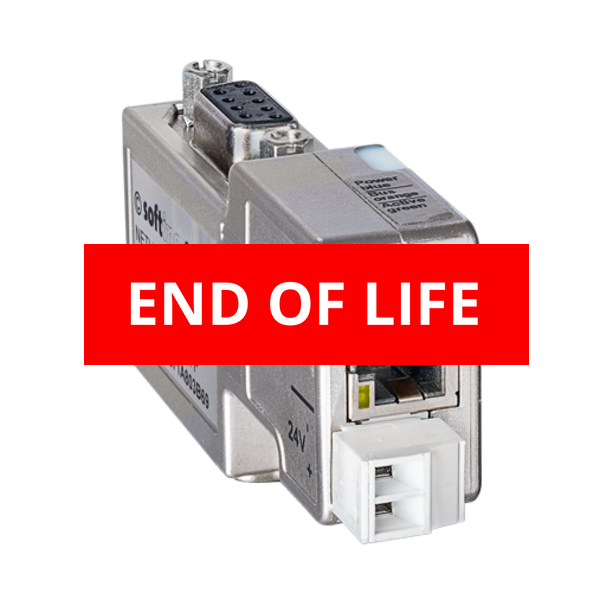

NETLink S7-Compact enables simple and fast integration of SIMATIC S7-200/300/400 controllers into Ethernet networks. Thus, programming, configuration and SCADA applications such as STEP7, TIA Portal, WinCC or OPC Server can access up to 32 automation devices in parallel in a robust and cost-effective manner. The adapter can be plugged directly into the MPI connector and replaces expensive communication processors. The pass-through programming socket allows the retroactive mounting of a piggyback device.
For configuration, NETLink S7-Compact can be integrated as a programming device in the STEP7 or TIA Portal development tools. In addition, a web interface is available for basic settings, e.g. PROFIBUS subscriber address or IP address. SIMATIC S7-200/300/400 controllers without Ethernet connection can also be connected to SIMATIC S7-1200/-1500 controllers with Ethernet connection via the adapter. NETLink S7-Compact can be powered directly from the SIMATIC S7 controller or via the 24 VDC connection.
Marcom OPC Server S7.Net. Quick and convenient access to the entire SIMATIC S7 PLCs S7-200, S7-300, S7-400, S7-1200, S7-1500 and the small LOGO via Ethernet network.
aplSwitch Field: 16 port Ethernet-APL Field Switch for Use in Zone 2
NL50MPI: Gateway for PLC S7 programmation through Ethernet. Web diagnostic PROFIBUS/MPI connected networks.
NT 50-MPI Connects to any free PROFIBUS/MPI/PPI port
Marcom S7.Net Snapshot. Quick save Datablock set values for the entire series SIMATIC S7 PLCs S7-200, S7-300, S7-400, S7-1200, S7-1500 and the small LOGO via Ethernet network.


 OPC Server S7.Net
 aplSwitch Field 16 port Ethernet-APL Field Switch for Use in Zone 2
 Ethernet-MPI Gateway
 NT50 MPI: Gateway Ethernet - MPI
 S7.Net Snapshot
 PROFIBUS / MPI